Car Out! Traffic Parking Games
- 4.7
- Rating
- 10.00M
- Installs
- Free
- Price
 Analysis by App-foxy
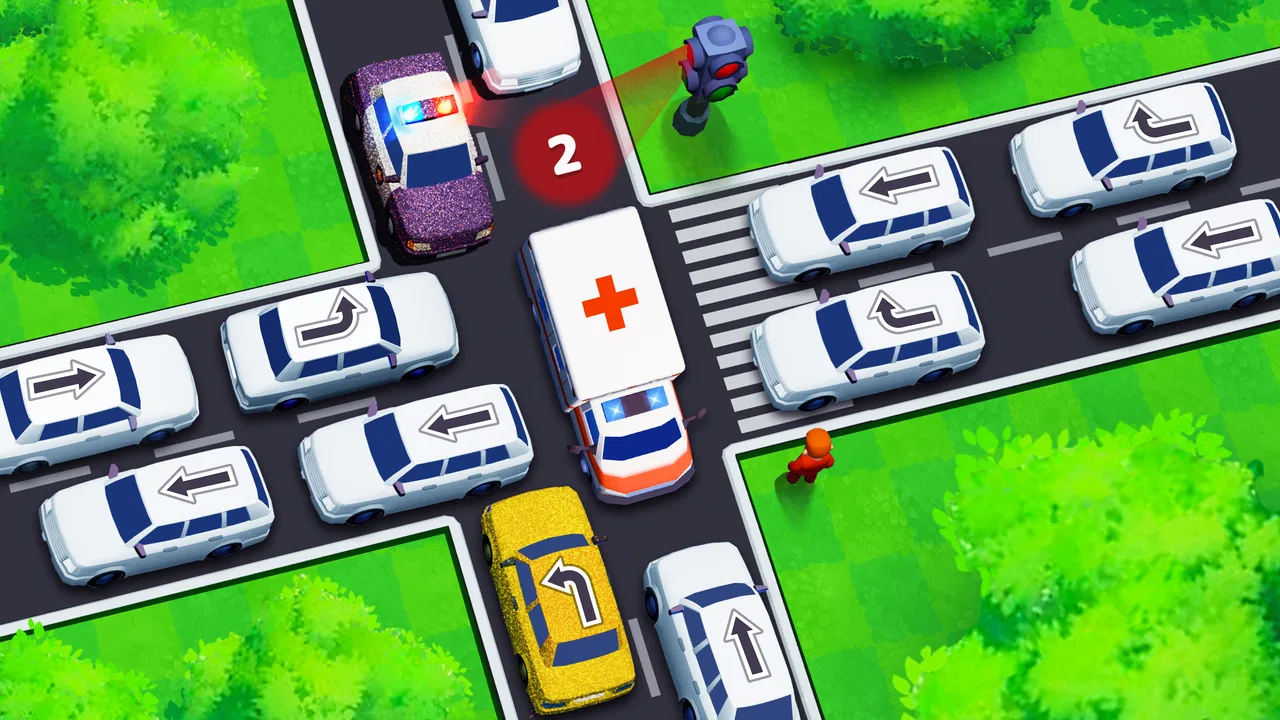
I find Car Out! Traffic Parking Games most enjoyable when I want a puzzle that starts quickly, explains itself without a long tutorial, and still makes me pause before every move. It is a free 3D traffic puzzle from Tripledot Studios Limited, built around freeing cars from a crowded layout by choosing a workable order. The idea sounds simple, but the fun comes from spotting which vehicle is actually blocking progress and which apparently easy move will create a worse jam.
That makes it a good fit for short breaks, especially when I am waiting for transport, taking a quick reset between tasks, or looking for something less demanding than a full strategy game. It is also easy to understand for younger players because it carries an Everyone age rating. At the same time, the bright presentation should not fool you into expecting a purely effortless experience. Later situations ask for planning, patience, and a willingness to restart rather than blindly tapping through the traffic.
How the current puzzle experience feels
The central challenge is visual rather than verbal. I look at a packed road scene, identify the cars that have a clear route, and work out how their movement can open space for the vehicles behind them. The three-dimensional view helps the board feel like a small traffic problem instead of a flat matching grid. I am not simply searching for identical symbols; I am reading lanes, exits, obstacles, and the order in which the board can be dismantled.
You May Also Like

 Blood Strike: 2.5 Anniversary
Blood Strike’s Loadouts Turn Every Drop Into a Tactical Gamble
A close look at Blood Strike’s custom loadouts: how fast access to signature weapons reshapes its battle royale rhythm, rewards preparation, and narrows the gap between fights.

 Pandora - Music & Podcasts
Pandora’s Music Is Easy to Start, but Harder to Recover
Pandora’s strength is its low-effort path from a seed to a station. Its weak spot is how much confidence it asks you to place in connection, setup, and quiet recovery.

 8 Ball Pool
 Is Built on Rivalries, Rematches, and Routine
A close look at the rivalries, rematches, shared routines, and unanswered safety questions that turn a quick pool match into a persistent mobile community.

 Samsung Music
’s Quiet Strength Is Playing What You Already Own
Its reach comes less from spectacle than from dependable access to a personal library. That simplicity is both the app’s strongest retention engine and its ceiling.

 AccuWeather: Weather Radar
AccuWeather Review: A Quick, Clear Forecast for Everyday Decisions
For everyday plans, the best forecast is the one you can understand quickly. AccuWeather makes rain timing, radar, and local conditions easy to act on, with a few trade-offs.

 Hill Climb Racing
Why Hill Climb Racing Still Turns Crashes Into One More Run
A tiny car, a bumpy hill and one more upgrade: Hill Climb Racing keeps resurfacing because its simple chaos makes every near-miss feel personal.
More From Our News Desk



That order is the important part. A car that appears ready to leave may be the wrong first choice if moving it prevents another vehicle from reaching its exit. I have found that the safest approach is to pause for a few seconds and trace several possible routes before touching the screen. This small habit makes the game feel more like a logic puzzle and less like trial and error.
The controls are approachable because the action is direct: I select or move a vehicle and watch how the scene changes. There is no need to learn a complicated control scheme. What takes practice is not the input but the prediction. A useful mental trick is to separate the board into immediate exits and future exits. I clear the cars that genuinely unlock space first, rather than automatically choosing the nearest vehicle.
That distinction gives the game more depth than its short description suggests. The traffic is not just decoration around a parking task. It is the puzzle itself. When I make a poor move, the result is usually understandable: I have blocked a route, ignored a dependency, or used a valuable opening too early. That clarity matters because a puzzle feels fair when I can see why my plan failed.
Why the three-dimensional view helps
The 3D presentation gives each level a sense of place and makes the traffic easier to read at a glance. Cars, road surfaces, and surrounding objects create a compact scene that feels more tactile than a conventional tile board. I can often recognize the key obstruction visually before I have consciously described it.
There is a trade-off, though. A more decorative scene can also make the board busier. When several vehicles overlap from my viewing angle, I need to inspect the layout carefully instead of relying on a quick glance. I recommend rotating or adjusting my attention rather than tapping rapidly. The game rewards observation, and rushing is the quickest way to turn a manageable board into a confusing one.
This is one reason I would not describe it as a background game for everyone. If I want something I can play while barely looking at the screen, a simple word puzzle or an audio-friendly game is a better choice. Car Out! asks me to watch the arrangement. Its strongest quality is also its main requirement: the visual board needs my attention.
Small habits that improve difficult boards
My first practical tip is to identify the vehicles that have no meaningful dependency. If a car can leave without disturbing the routes of others, it is often a safe candidate, but I still check whether its movement consumes space needed by a more important vehicle. The second tip is to look for bottlenecks. One narrow opening can control the entire board, so I treat the cars around it as a group rather than solving each vehicle separately.
A third useful habit is to remember the failed sequence for a moment after restarting. Restarting is not wasted time if it tells me which move caused the jam. I use the next attempt to change one decision at a time, which makes the puzzle easier to understand. Randomly trying a completely different series of taps usually teaches me less.
I also find it helpful to solve from the exit backward. Instead of asking which car I can move now, I ask which vehicle must eventually reach a particular opening and what needs to be cleared before that can happen. This reverse view is especially useful when the front of the traffic looks open but the deeper lanes are locked by one misplaced vehicle.
What the release and current version suggest
The game was released on December 6, 2023, and the current version is 1.24.0. Those details place it in a more established stage than a brand-new puzzle experiment. In my view, that matters because a game with a substantial install base has had time to become a familiar pick-up-and-play option rather than a concept that still needs to prove its basic loop.
The current version is available for devices running Android 6.0 or later. That gives the game a broad technical reach, although the actual comfort of play will still depend on the phone or tablet. The 3D scenes are easier to enjoy on a screen where vehicles and routes remain clear, so I would prefer a reasonably sized display if I planned to play for longer sessions.
Its audience is also sizeable: the game has passed ten million installs, with an average rating of 4.5 from around one hundred one thousand ratings and about four thousand five hundred written reviews. I read those figures as evidence that the basic traffic-puzzle formula connects with many players, not as a guarantee that every player will enjoy the pacing or monetization.
For someone installing it today, the important point is that the current build should be judged as a mature, actively recognizable version of the game rather than solely by its original launch premise. I would still keep expectations grounded. A version number does not automatically tell me that every personal annoyance has been removed, and it does not turn a casual puzzle into a deep simulation. It simply indicates that the product has progressed beyond its first release.
How updates affect returning players
If I played near launch and return now, the most useful way to assess the change would be to focus on the day-to-day feel: how quickly a level begins, how readable the traffic is, how clearly a failed plan communicates its mistake, and whether the overall rhythm still suits short sessions. Those are the areas that determine whether I keep the game installed.
I would not return expecting a completely different genre. The appeal remains the compact act of arranging movement through a jam. That consistency is positive for players who already understand the loop, because I can pick it up again without relearning a complex system. It may be less exciting for anyone hoping that each update transforms the game into a large-scale parking simulator or a story-driven adventure.
For new users, the current version is easier to evaluate on its own terms. I can play a few puzzles, decide whether the visual logic clicks with me, and see whether the challenge feels satisfying rather than frustrating. The free entry point makes that trial straightforward, but I still pay attention to how optional purchases fit into my own habits before committing to longer play.
Free access and the purchase question
Car Out! is free to download and play, with in-app purchases listed from $0.99 to $499.99 per item. That range is important context for anyone who manages spending carefully, particularly parents considering the game for a child. The Everyone rating describes the content audience, not a promise that every purchase decision will be suitable for every household.
My advice is simple: treat the free version as a complete test of whether the puzzle loop works for you, and decide in advance whether you want to spend anything. I would not buy merely because a difficult board has made me impatient. A stuck moment is often a signal to inspect the order again, restart, or take a break. Spending can make sense only if the value feels clear to you and your device’s purchase controls are protected.
This is also where the game differs from a traditional paper puzzle book. With a book, the cost is usually understood upfront and the challenge is fixed on the page. Here, the free starting point is more convenient, but the presence of optional purchases means I need to be more deliberate about boundaries. That does not cancel the enjoyment; it changes how I recommend using it.
Where it stands beside other puzzle choices
Compared with match-three games, this one asks for spatial planning instead of pattern recognition. I am not building a chain of colors or waiting for a lucky combination. Every vehicle has a practical role in opening or restricting the board, so success depends more on sequencing than on quick reactions.
Compared with classic sliding-block puzzles, the traffic setting makes the objective more immediately readable. I can understand the goal from the scene itself, while the 3D vehicles give the board a more animated personality. The trade-off is that a traditional sliding puzzle may offer a cleaner, more abstract view of every move. If I prefer pure geometry without visual clutter, a minimalist alternative could suit me better.
It also differs from a full parking simulator. I am not practicing realistic steering, reversing, or vehicle handling. The focus is the logic of clearing a jam, not the physical skill of parking a car. That makes it friendlier for casual puzzle sessions, but it will disappoint anyone seeking driving mechanics, realistic traffic rules, or a detailed vehicle sandbox.
Against word games, Car Out! is more dependent on visual focus and less useful when I am tired of reading. Against action games, it is calmer and more forgiving of slow thinking, but it lacks the excitement of timing-based play. I see it as a middle ground: active enough to occupy my attention, quiet enough for a short mental break.
Who should play it, and who should skip it
I would recommend it to players who enjoy untangling a visible problem one decision at a time. It works particularly well for people who like short levels, visual feedback, and puzzles that can be understood without a large ruleset. Families may also appreciate the accessible premise, provided an adult handles purchase restrictions and explains that free access does not mean every optional item should be selected.
It is a good companion for a realistic everyday scenario: I might have ten minutes before an appointment, open the game, solve a few traffic layouts, and stop without needing to remember a long story or rebuild a complicated strategy. If I am interrupted, the simple objective makes it easier to return to the same kind of thinking later.
I would skip it if I need a completely ad-free, purchase-free experience, although individual tolerance varies. I would also choose another game if I want competitive multiplayer, a deep campaign, realistic driving, or puzzles with a single clean mathematical solution and no decorative presentation. Players who dislike restarting after a poor sequence may find the traffic-jam structure irritating rather than satisfying.
People with visual discomfort should be selective about longer sessions. The 3D layout is part of the appeal, but it can require careful inspection when vehicles overlap or the board becomes crowded. I would play on a comfortable screen, take breaks, and avoid treating it as something to rush through.
What I would watch as the game continues
The most meaningful future progress would be improvements that preserve the clarity of the traffic logic while reducing unnecessary friction. I would watch for how new layouts maintain fairness, whether the visual design keeps important routes easy to distinguish, and whether the difficulty grows through smarter dependencies rather than simply adding more clutter.
I would also pay attention to the balance between free play and optional spending. A casual puzzle is at its best when I feel encouraged to think, not pressured to purchase because I made one mistake. Clear choices and sensible pacing would help the game remain welcoming to the broad audience suggested by its Everyone rating and large player community.
For existing users, the key question is whether returning still feels immediately comfortable. The current version number shows ongoing product development, but what I personally value is practical continuity: familiar controls, readable boards, and enough fresh situations to justify another short session. For new users, the free price is an easy invitation to test that experience without making a large commitment at the start.
My final view is that Car Out! succeeds because it turns a common traffic jam into a clear sequence of logical decisions. I like that the best move is not always the most obvious one, and I appreciate how a quick puzzle can become surprisingly absorbing when I start thinking several moves ahead. Its limitations are real: the visual board demands attention, the experience is not a driving simulator, and the purchase range deserves careful handling.
Still, I would recommend it to a friend who wants a lightweight but thoughtful puzzle for Android or iOS. I would begin with the free experience, play slowly enough to understand the bottlenecks, and decide afterward whether it fits my habits. If that combination of colorful traffic, short sessions, and forward planning sounds appealing, this is a strong candidate; if I want pure abstraction, realistic parking, or a fully fixed-price game, another puzzle style will probably serve me better.
FAQs for Car Out! Traffic Parking Games
01What is the main objective of Car Out! Traffic Parking Games?
Car Out! Traffic Parking Games challenges players to strategically maneuver vehicles out of congested parking lots. The main objective is to free your car from a gridlocked scenario by sliding other vehicles out of the way. Each level presents a unique puzzle that requires critical thinking and planning to solve.
02Is Car Out! suitable for all age groups?
Yes, Car Out! is designed to be enjoyable for players of all ages. The game's intuitive controls and progressively challenging levels make it accessible to younger audiences while still providing enough complexity to engage adults. It’s a great way to improve problem-solving skills and spatial awareness.
03Does Car Out! require an internet connection to play?
Car Out! can be played offline, making it a great option for on-the-go entertainment. However, certain features such as daily challenges or leaderboards may require an internet connection to access. Offline play ensures that you can enjoy the game anytime and anywhere without worrying about connectivity.
04Are there in-app purchases in Car Out!?
Yes, Car Out! offers in-app purchases that allow players to buy hints or unlock additional content. While the game is free to download and play, these optional purchases can enhance the gaming experience. Players should be aware of these options, especially if children are playing the game.
05What devices are compatible with Car Out!?
Car Out! is available for both Android and iOS devices. It supports a wide range of smartphones and tablets, ensuring broad compatibility. Players should ensure that their device meets the minimum system requirements for optimal performance, typically involving the latest operating system updates.
Pros
- Engaging puzzles keep you hooked.
- Intuitive controls for all ages.
- Colorful graphics add to fun.
- Regular updates with new levels.
- Offline play available anytime.
Cons
- Ads can be disruptive.
- Limited free hints available.
- In-app purchases can be pricey.
- Some levels feel repetitive.
- Occasional minor bugs.

Car Out! Traffic Parking Games
Gallery